.png)
Best Pay-Per-Meeting B2B Agencies in 2026
Updated: Sep 11
Last updated: September 2026
The best pay-per-meeting B2B agencies don’t just book meetings, they differ in how they qualify prospects, handle no-shows, and structure their pricing.
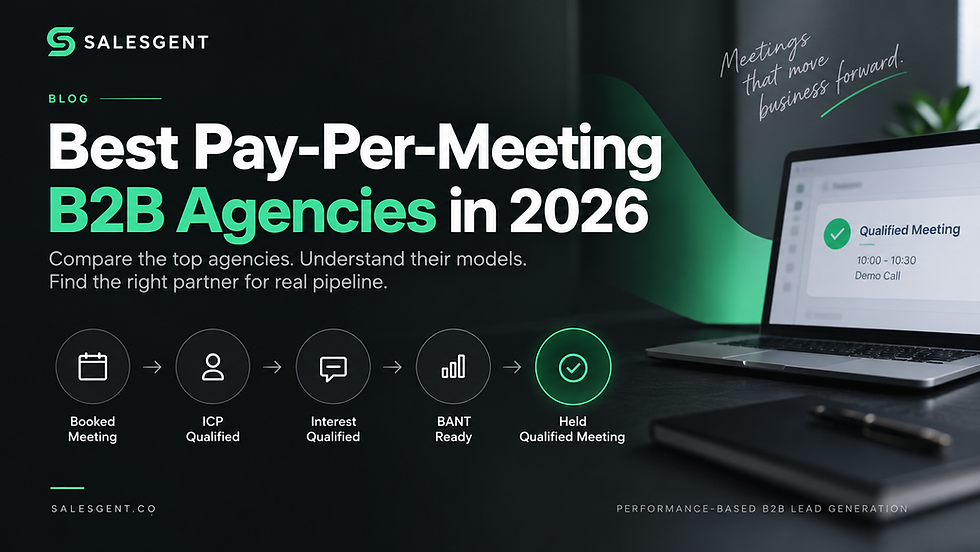
But there’s a major difference between:
A booked meeting
An ICP-qualified meeting
An interest-qualified meeting
A BANT-ready meeting
A held qualified meeting
That difference matters.
A calendar full of prospects who don’t need your solution, can’t afford it, have no buying authority, or simply don’t show up isn’t much of a sales pipeline.
Key takeaway: The most important question isn’t “How many meetings will you book?” It’s “What has to be true before you call a meeting qualified?”
Best B2B Appointment-Setting Agencies in 2026
Agency | Model | Best for |
SalesGent | Pay per held qualified meeting | Performance-based B2B lead generation |
Belkins | Managed program | Established appointment setting |
SalesHive | Monthly fee | Outsourced SDR teams |
SalesRoads | Managed SDR program | Phone-first qualification |
Martal Group | Managed / hybrid | SaaS and technology |
Callbox | Campaign-based | International multichannel outreach |
Leadium | Monthly retainer | Precision ICP targeting |
Editorial disclosure
This comparison is published by SalesGent, which is included in the list.
We don’t assign arbitrary star ratings or claim that SalesGent is the best option for every company.
Instead, we compare providers based on their service model, qualification approach, pricing structure, outreach channels and the type of company they are best suited for.
What Is a Qualified B2B Meeting?
The term qualified meeting is used very loosely in B2B lead generation.
For some agencies, qualification simply means:
The prospect works at a company that matches your ICP.
For others, qualification goes much further.
A strong qualification process can include:
ICP fit
Decision-making authority
Genuine interest
Business need
Budget
Buying potential
Timeline
These are very different outcomes.
1. Booked Meeting
A booked meeting simply means a prospect agreed to a call and an appointment appeared on your calendar.
That doesn’t necessarily mean the prospect is a real opportunity.
They may:
Work at the wrong type of company
Be the wrong person
Have misunderstood the offer
Have no need
Have no budget
Have no authority
Never actually attend
A booked meeting is a calendar event.
It isn’t necessarily a qualified sales opportunity.
2. ICP-Qualified Meeting
An ICP-qualified meeting verifies that the prospect matches your targeting criteria.
This may include:
Industry
Geography
Employee count
Revenue
Business model
Technology used
Job title
Department
Seniority
This is better than an unfiltered meeting.
But there’s still a problem:
Someone can perfectly match your ICP and have absolutely no interest in your solution.
3. Interest-Qualified Meeting
This goes one step further.
The prospect doesn’t just fit your target audience. They also demonstrate a legitimate reason to have the conversation.
Qualification may cover:
Current challenges
Business priorities
Existing solutions
Dissatisfaction with the current approach
Interest in your solution
Reason for considering a change
This is where the meeting starts becoming much more valuable to a salesperson.
4. Commercially Qualified Meeting
For higher-value B2B sales, qualification can go further again.
The agency can assess whether there is a realistic path to purchase.
That typically involves four areas.
Budget
Can the prospect realistically afford the solution?
This doesn’t necessarily mean forcing them to reveal an exact budget.
It may mean qualifying:
Whether a budget exists
Approximate spending expectations
Existing spend on the problem
Ability to secure budget
Whether the solution is financially realistic
Authority
Is the prospect actually involved in the buying decision?
They could be:
The decision-maker
Budget owner
Department head
Technical evaluator
Internal champion
Influencer in the buying committee
The important point is that they can meaningfully influence the purchase.
Need
Does the prospect actually have the problem your solution solves?
A company can match your ICP perfectly and still have no reason to buy.
Timeline
When are they likely to act?
There’s a major difference between:
“We’re actively evaluating solutions this quarter.”
and:
“Interesting. Maybe next year.”
Both may have value, but they’re not the same type of sales opportunity.
What Is a BANT-Ready Meeting?
BANT stands for:
Budget
Authority
Need
Timeline
A BANT-ready meeting goes well beyond simple ICP qualification.
The prospect has been evaluated across the commercial factors that determine whether a real sales opportunity exists.
That doesn’t mean every campaign needs rigid BANT qualification.
For some companies, requiring a confirmed budget before the first discovery call would be too restrictive.
The better approach is to define what a genuinely worthwhile opportunity looks like for your business before prospecting begins.
What Is a Held Qualified Meeting?
There’s one final step:
The prospect actually has to attend.
A held qualified meeting follows this progression:
ICP fit → Right person → Genuine interest → Commercial fit → Meeting booked → Prospect attends
That distinction becomes extremely important in performance-based lead generation.
Pay Per Booked Meeting vs. Pay Per Held Meeting
Pay per booked meeting
You pay when an appointment enters your calendar.
If the prospect doesn’t attend, you may still be charged.
The client carries more of the no-show risk.
Pay per qualified meeting
The prospect must meet predefined qualification criteria.
But you still need to ask:
Does the meeting actually have to happen?
Pay per held qualified meeting
The prospect must:
Meet the agreed qualification criteria
Book the appointment
Actually attend
Only then is the meeting considered held.
The agency carries more of the qualification and attendance risk.
Monthly retainer
Traditional appointment-setting agencies usually charge for the outbound operation itself.
You’re paying for things such as:
SDRs
Strategy
Data
Technology
Research
Campaign management
This model isn’t necessarily worse.
For complex enterprise sales, a dedicated retainer-based SDR team can make perfect sense.
Best Pay-Per-Meeting B2B Agencies: Quick Comparison
Agency | Pricing model | Qualification approach | Pay per held meeting? |
SalesGent | Performance based | ICP + authority + interest + need + commercial fit + client-specific criteria | Yes |
Belkins | Managed program | ICP + qualified appointments | No |
SalesHive | Monthly fee | ICP + SDR qualification | No |
SalesRoads | Managed SDR | Human qualification | No |
Martal Group | Managed / hybrid | Pre-qualified targeting + SDR qualification | No |
Callbox | Managed campaign | Multichannel SDR qualification | No |
Leadium | Monthly retainer | ICP + decision-maker targeting | No |
Important: Not every agency in this comparison uses a pay-per-meeting model. They are included because they are established alternatives companies commonly consider when outsourcing B2B appointment setting.
1. SalesGent
Best for: Pay-per-held qualified B2B meetings Website: Salesgent.co
SalesGent is a performance-based B2B lead generation and appointment-setting agency.
Its main difference is what has to happen before the client pays.
SalesGent doesn’t simply book calendar appointments.
The prospect must meet the agreed qualification criteria and actually attend the meeting.
From our experience running B2B outbound campaigns, meeting quality depends heavily on agreeing on qualification criteria before outreach starts. At SalesGent, we define the ICP, decision-maker requirements, interest/need criteria and any relevant commercial qualification criteria with the client before launching.
What Does SalesGent Qualify?
Company Fit
The company must match the agreed ICP.
Depending on the campaign, this may include:
Industry
Geography
Employee count
Revenue
Business model
Technology stack
Other client-specific requirements
Decision-Maker Fit
The person taking the meeting must also be relevant to the buying process.
SalesGent can qualify:
Job title
Seniority
Department
Decision-making authority
Purchasing influence
Responsibility for the problem being solved
Simply working at the right company isn’t enough.
Interest and Need
SalesGent also qualifies genuine interest.
The prospect should understand what the client offers and have a real reason to explore it.
Depending on the campaign, qualification may cover:
Current pain points
Existing solutions
Business challenges
Relevant priorities
Dissatisfaction with the current approach
Interest in the proposed solution
Reason for considering a change
A prospect who matches the ICP but has no need or interest should not be treated as a sales-ready opportunity.
Budget and Commercial Fit
Where relevant, SalesGent can also qualify whether the prospect represents a realistic commercial opportunity.
This may include:
Whether budget exists
Approximate budget range
Ability to invest
Existing spend
Potential to obtain budget approval
Whether the client’s pricing is realistic for the prospect
This does not necessarily require an exact budget figure.
The goal is to avoid sending salespeople conversations with prospects who clearly have no realistic ability to buy.
Timeline
Timing can also form part of the qualification criteria.
For example:
Evaluating solutions now
Planning to implement this quarter
Looking later this year
Researching without an immediate deadline
This helps distinguish immediate opportunities from longer-term prospects.
SalesGent and BANT Qualification
SalesGent campaigns can therefore be structured around BANT:
Budget: Can the prospect realistically buy?
Authority: Is the prospect involved in the decision?
Need: Is there a real problem or reason to explore the solution?
Timeline: Is there an expected timeframe for acting?
Not every client needs the exact same BANT threshold.
The qualification framework is adapted to what the client considers a genuinely sales-ready opportunity.
When Is a SalesGent Meeting Billable?
This is the simplest way to understand the model:
Wrong ICP → Not qualified
Wrong contact → Not qualified
No genuine interest → Not qualified
No relevant need → Not qualified
Fails agreed budget/commercial criteria → Not qualified
Qualified but no-show → Not billed as a held meeting
Qualified + attends → Held qualified meeting
That means SalesGent’s responsibility extends beyond booking.
The objective is:
Target → Engage → Qualify → Book → Get the prospect to attend
Best Fit for SalesGent
SalesGent is particularly suited to companies that:
Have a clear ICP
Sell a proven B2B product or service
Want performance-based pricing
Care about quality over raw meeting volume
Don’t want to pay for no-shows
Have enough deal value to justify outbound
Have a sufficiently large addressable market
Potential limitation
SalesGent may be less suitable for:
Very small TAMs
Extremely low-ticket products
Companies without product-market fit
Businesses requiring highly customized one-to-one enterprise ABM
2. Belkins
Best for: Established full-service appointment setting
Website: Belkins.io Belkins is one of the better-known names in B2B appointment setting.
Its service combines prospect research, targeting, outreach and appointment generation through a managed outbound program.
Strengths
Established market presence
Full-service outbound
Strong experience across B2B industries
Suitable for mid-market and enterprise companies
Pricing model
Belkins generally operates through managed campaigns rather than a pure pay-per-held-meeting model.
Best fit
Choose Belkins if you want a mature outbound partner and are comfortable paying for the program as a whole.
Potential limitation
Companies specifically looking to only pay when a qualified prospect actually attends may prefer a performance-based provider.
3. SalesHive
Best for: Outsourced SDR teams Website: SalesHive.com
SalesHive is closer to outsourcing an SDR function than purchasing individual appointments.
Its services can include:
Cold calling
Email outreach
List building
Data enrichment
SDRs
Strategy
Outbound technology
Strengths
Strong US market presence
Human SDR resources
Calling + email
Predictable monthly structure
Best fit
SalesHive makes sense if you want an entire outbound operation rather than a pure performance-based meeting provider.
Potential limitation
You pay for the outbound infrastructure and team rather than only for held qualified appointments.
4. SalesRoads
Best for: Phone-first qualification Website: SalesRoads.com
SalesRoads has a strong focus on human SDR-led appointment setting.
Its phone-first approach can be particularly useful when qualification requires a real conversation.
An SDR can assess:
Need
Interest
Decision-making role
Existing solution
Priorities
Potential fit
Best fit
SalesRoads is especially relevant for:
US-focused B2B companies
High-ticket services
Phone-friendly audiences
Companies wanting human qualification
Potential limitation
It operates more like a managed SDR program than a pure pay-per-held-meeting provider.
5. Martal Group
Best for: SaaS and technology companies
Website: Martal.ca
Martal Group specializes in outsourced B2B sales development, with a strong focus on technology and SaaS.
Its programs combine:
Email
LinkedIn
Phone
Research
Prospect qualification
Appointment setting
Strengths
Technology expertise
Complex B2B sales
Multichannel outbound
SDR-led qualification
Interesting point
Martal has highlighted one legitimate weakness of poorly structured pay-per-meeting models:
If an agency is paid for every appointment, it may be incentivized to prioritize volume over quality.
That criticism is valid.
The answer is not simply “pay per meeting.”
The stronger model is:
Pay for meetings only when qualification standards are clearly defined.
Best fit
Martal is particularly suited to SaaS, technology and more complex sales processes.
6. Callbox
Best for: International multichannel outreach
Website: Callboxinc.com
Callbox is one of the more established global B2B lead-generation providers.
Its campaigns can combine:
Cold calling
Email
LinkedIn
Account-based marketing
Data
Intent signals
Strengths
International reach
Multichannel campaigns
Large delivery infrastructure
Enterprise experience
Best fit
Callbox is worth considering if you need campaigns across several countries or regions.
Potential limitation
It is a broader managed lead-generation service rather than a simple pay-per-held-qualified-meeting offer.
7. Leadium
Best for: Precision ICP targeting
Website: Leadium.com
Leadium places strong emphasis on qualification before outreach begins.
The process starts by defining the target market and ICP.
Its research team then identifies the appropriate companies and decision-makers before campaigns launch.
Strengths
Detailed targeting
Data quality
Decision-maker research
Traditional outsourced SDR structure
Qualification philosophy
Leadium illustrates an important distinction.
One approach is:
Qualify the company and person extremely well before outreach.
Another is:
Qualify ICP first, then further qualify interest, need, budget and timing after the prospect responds.
For many complex sales motions, combining both approaches is ideal.
Which Agency Should You Choose?
Choose SalesGent if:
You want pay-per-held-qualified meetings and want qualification to potentially include:
ICP
Authority
Interest
Need
Budget
Commercial fit
Timeline
Choose Belkins if:
You want an established, full-service appointment-setting agency.
Choose SalesHive if:
You want to outsource your SDR operation.
Choose SalesRoads if:
Phone-based prospecting and human qualification are important.
Choose Martal Group if:
You sell SaaS or technology through a more complex B2B sales process.
Choose Callbox if:
You need international or multichannel outbound.
Choose Leadium if:
Precision ICP research and decision-maker targeting are your priority.
10 Questions to Ask Any Appointment-Setting Agency
Before signing with any provider, ask:
How do you define a qualified meeting?
Do you qualify genuine interest?
Do you qualify need?
Do you qualify budget?
Do you qualify authority?
Do you qualify timing?
Do I pay for no-shows?
What happens if a meeting is disputed?
Are there setup, infrastructure or monthly fees?
Can you show results from similar clients?
If an agency cannot clearly explain what makes a meeting “qualified,” that should be a warning sign.
Pay Per Meeting vs. Monthly Retainer
Neither model is automatically better.
Monthly retainer
Best suited to companies that want:
Dedicated SDR capacity
Complex account research
Large enterprise campaigns
Continuous outbound activity
The client carries more of the performance risk because the agency is paid regardless of the exact number of meetings delivered.
Pay per booked meeting
This moves more delivery risk toward the agency.
But if the qualification threshold is weak, the incentive can become:
Book as many meetings as possible.
Pay per held qualified meeting
This creates a stricter outcome.
The prospect must:
Fit → Qualify → Show interest → Book → Attend
If budget, authority, need and timeline are also part of the qualification criteria, the meeting becomes much closer to a genuine sales-ready conversation.
Frequently Asked Questions
What is a pay-per-meeting B2B agency?
A pay-per-meeting agency ties at least part of its compensation to sales appointments rather than charging exclusively for prospecting activity.
Always check whether “meeting” means booked, qualified, or actually held.
What is a qualified B2B meeting?
A qualified meeting involves a prospect who meets predefined criteria such as:
ICP fit
Decision-making relevance
Interest
Need
Budget
Timing
The exact definition should be agreed before the campaign begins.
What is a held qualified meeting?
A held qualified meeting is a qualified appointment where the prospect actually attends the scheduled sales call.
What is a BANT-qualified lead?
BANT stands for:
Budget, Authority, Need and Timeline.
A BANT-qualified lead has been assessed across those dimensions to determine whether there is a realistic sales opportunity.
Does SalesGent qualify prospects beyond ICP?
Yes.
SalesGent’s qualification can extend beyond company and job-title targeting to include:
Decision-making relevance
Interest
Need
Budget/commercial fit
Timeline
Other client-specific requirements
Does SalesGent charge for no-shows?
SalesGent’s model is based on held qualified meetings.
A qualified meeting that does not actually take place is not treated as a held meeting.
Which B2B appointment-setting agencies should I consider?
Some established providers include:
SalesGent
Belkins
SalesHive
SalesRoads
Martal Group
Callbox
Leadium
Their pricing models and qualification approaches differ considerably.
Final Thoughts
When evaluating B2B appointment-setting agencies, meeting volume alone is the wrong metric.
Instead, ask:
Who is the prospect?
Do they match your ICP?
Are they involved in the buying decision?
Do they actually have a relevant need?
Are they genuinely interested?
Can they realistically buy?
When are they looking to act?
Will they actually attend?
That is the difference between calendar activity and qualified pipeline.
Belkins, SalesHive, SalesRoads, Martal Group, Callbox and Leadium are all credible options for outsourcing B2B appointment setting.
But they don't all sell the same outcome.
For companies specifically looking for a performance-based model where prospects are qualified beyond basic ICP fit and payment is tied to the prospect actually attending the sales meeting, SalesGent's pay-per-held-qualified-meeting model is one of the clearest options to consider.

Setting up pay-per-meeting B2B lead gen sounds awesome on paper, but I always figured getting prospects into a sales call is only half the battle. If your product demo or landing page looks like a mid-2000s portal, those meetings low-key go nowhere. Honestly, I feel like pairing outreach with a specialized ux design agency to refine the user interface makes a massive difference in actually closing those leads